The Race
With the Democrats’ demoralizing defeat in 2024 still fresh in many people’s heads, Zohran’s campaign has come as a breath of fresh air—a renewed sense of hope that Kamala Harris was unable to achieve in the last presidential race. And on the surface, it seems puzzling why the two candidates had such drastically different levels of success. After all, Harris found herself up against billionaire, now approaching trillionaire Elon Musk’s donations of nearly $300 million. Zohran, too, faced astonishingly high donations against him from the three largest super PACs in the race, all supporting Cuomo. Most notably, Fix the City spent $5.3 million to run just one attack ad against Mamdani—the most expensive ad of the 2025 election cycle. These super PACs were funded by major corporations like Airbnb and Doordash, as well as wealthy individuals like billionaire Bill Ackman, five members of the billionaire Lauder family, and former mayor Michael Bloomberg. In lieu of this information, what allowed Mamdani to beat the odds and not Harris?
Some argue that Mamdani’s victory was an inevitable result of electing Trump. As the entire federal government seemed to swing right, they reasoned that an equal swing to the left must follow, especially given the political chaos of the Trump administration. Others point to Mamdani’s unique social media campaign and vibrant campaign communications. But to chalk up his historic win as just a reaction to Trump would be an oversimplification—after all, Andrew Cuomo was a former Democratic governor. Zohran didn’t even receive endorsements from key figures in the Democratic Party. One must look to the details of the race to find the full answer.

When Mamdani first announced his candidacy in October 2024, he was a complete nobody. In February 2025, his support in the polls was at 1%. But four months later, he defeated former governor Andrew Cuomo in the Democratic primary by thirteen points. While Cuomo, the frontrunner and Mamdani’s foremost opponent, campaigned in the way most expect political campaigns to be run—from a distance—Zohran began to distinguish himself over time with his focus on speaking directly to voters. His field operation was extensive; over the course of the primary election alone, his volunteer base knocked approximately 1 million doors across New York City. In the general election (June-November), the Mamdani campaign more than doubled this number, canvassing 3 million voters. For reference, the Mikie Sherrill for Governor campaign here in New Jersey knocked about 1.5 million doors during the general election season. When the TV ads and mailers got exhausting, it was clear that many voters found a face-to-face interaction with a volunteer to be far more persuasive. This authenticity was also felt in Zohran’s campaign appearances. The week leading up to the primary election, June 24th, he embarked on a walk across the length of Manhattan, beginning on a Friday night and continuing over the next few days, during which he interacted directly with voters. When posting footage of the walk, he asserted that “New Yorkers deserve a Mayor they can hear, see, and even yell at if they need to.” After winning the primary, Mamdani’s campaign also hosted several events directly engaging their voter base, including a citywide scavenger hunt, the Cost-of-Living Classic soccer tournament, and campaigning at the NYC marathon. During the first general election debate, they released bingo boards for supporters to print and play while watching the debate (I did not win). And throughout the race, Mamdani could be found across New York City speaking to voters. In September, he made a surprise appearance at the All Things Go festival with performer Lucy Dacus. At the start of November, he appeared at a Brooklyn LGBTQ+ bar at 1 a.m. to campaign. He also visited various senior centers, dancing and even doing tai chi with residents. Mamdani’s record as an Assemblyman reflects this same focus. In 2021, he participated in a 15-day hunger strike with NYC taxi drivers in front of City Hall. Crushed with debt from the high cost of medallions, permits required for taxi drivers to be able to transport passengers in the city, the strike began after several drivers committed suicide, and ended with an agreement that secured debt relief. But not only was Mamdani a “people over politics” figure, in the Assembly and the mayoral race alike, his campaign was hopeful. His campaign, in many ways, was fun. What other politician was running a soccer tournament in the middle of a race for mayor of America’s largest city?

Another major contributor to Zohran’s initial victory was his competition. The Democratic primary was crowded—with candidates ranging from a former governor to the city comptroller to a former hedge fund manager—but with New York City’s rank-choice voting system, Zohran was able to effectively form coalitions with other candidates, most notably Brad Lander and Michael Blake. With rank-choice voting, voters can rank candidates in order of preference, preventing “vote-splitting.” This allowed many of the candidates running in the primary to cross-endorse each other, with Mamdani and Lander issuing cross-endorsements and directing their supporters to rank them first and the other second. Mamdani and Blake later did the same. Lander also actively campaigned with Mamdani in the later half of the primary and throughout the general, appearing at Zohran’s victory party in June and later remarking, “People, it turned out, were so hungry for a more hopeful and collaborative form of politics.” Other progressive groups, like the Working Families Party, also endorsed Mamdani as their #1 choice, along with Lander as #2, and a slate of other candidates, including Adrienne Adams, Zellnor Myrie, and Jessica Ramos (Ramos was later removed from this slate after she endorsed Cuomo).
Mamdani and his allies also made sure to emphasize: “Don’t rank Cuomo” to ensure that if multiple rounds of rank-choice voting were needed, Zohran would likely come out on top. Aside from the unique cross-endorsements, Zohran gained further traction in the race with endorsements from well-known progressive figures in the Democratic Party: namely, Senator Bernie Sanders and Rep. Alexandria Ocasio-Cortez. Other local politicians included former Rep. Jamaal Bowman, NY Attorney General Letitia James, and City Councilman Chi Ossé, along with out-of-state figures such as former Secretary of Labor Robert Reich and Newark Mayor Ras Baraka, a progressive Democrat who lost to and later endorsed Mikie Sherrill for governor of New Jersey. But what may have contributed just as much to Zohran’s success was the endorsement not received. Following his primary win, NY Governor Kathy Hochul declined to endorse Mamdani, as did Democratic House Minority Leader Hakeem Jeffries. Both would eventually issue endorsements, but many other prominent New York Democrats did not. Senate Minority Leader Chuck Schumer did not endorse any candidate, and the other NY Senator, Kirsten Gillibrand, claimed Mamdani supported “global jihad” on the Brian Lehrer show, facing significant criticism and accusations of Islamophobia. Rep. Ritchie Torres, who represents the Bronx, endorsed Andrew Cuomo in the primary. Rep. Laura Gillen, Tom Suozzi, and Dan Goldman all released statements condemning Zohran for what they deemed antisemitism. Ironically, Mamdani won Rep. Goldman’s congressional district by over thirty points. Even in New Jersey, there seemed to be an unwillingness to accept Mamdani as the Democratic nominee. Rep. Josh Gottheimer remarked on CNN that Mamdani “should be in the Socialist Party, not in the Democratic Party.” Initially, Mikie Sherrill expressed tentative support for Zohran, saying she would back him in the general election if he were the Democratic nominee and that some of his affordability policies were “interesting.” Mamdani had said in an interview that he would “absolutely” support her. However, she later decided to keep her distance, claiming in a July interview, “I haven’t weighed in, I haven’t made endorsements in New York, because I’m running in New Jersey.” NJ Senator Cory Booker said the same, declining to endorse and saying he was focused on New Jersey, although some pointed out that he had previously endorsed Michael Bloomberg for NYC mayor in 2009 and has since endorsed several other out-of-state candidates. But while the lack of these endorsements doesn’t look good at first, it may have been a blessing in disguise for the Mamdani campaign. The Democrats’ approval rating fell to record lows of 34% earlier this year, with approval for party leaders like Schumer being even lower, even among the Democratic base. With Zohran presenting himself as a changemaker and an anti-establishment candidate, the backlash he received from moderate, “establishment,” Democrats may have strengthened, rather than hurt, his credibility.
There was also the special case of Zohran’s general election opponents, Democrat-turned-independent Andrew Cuomo and Republican Curtis Sliwa (not to mention the various “anti-Mamdani” candidates, like incumbent Democrat-turned-independent Eric Adams and independent Jim Walden, who dropped out of the race). The presence of so many “anti-Mamdani”s in a race without rank-choice voting certainly helped to split opposition against Zohran. However, the conservative crowd eventually coalesced behind Andrew Cuomo, with only a few stalwart Republicans supporting Sliwa in the end—likely due to the endorsements of Trump, Elon Musk, Ted Cruz, and various other right-wing figures that Cuomo received the day before Election Day. Trump also threatened to pull federal funding from NYC should Mamdani win. After the Democratic primary, Cuomo had already begun courting conservative voters, claiming at a closed-door fundraiser in August that he was confident Trump would tell the Republican base to support him over Sliwa. He was later endorsed by Eric Adams, who had also become more friendly toward the Trump administration, likely due to the Trump DOJ’s dismissal of the corruption charges—an incident that led several prosecutors to resign in protest. Regardless of the boost Cuomo got, he still faced attacks from Sliwa, who adamantly refused to drop out and claimed that, if anything, Cuomo should step aside and endorse him as the “anti-Mamdani” candidate. The lack of cohesion in the conservative base, along with Cuomo’s record being riddled with scandals—from sexual harassment allegations from thirteen women, undercounting senior nursing home deaths by nearly 50%, and haphazard management of the MTA, to joining Israeli Prime Minister Benjamin Netanyahu’s legal defense team against the ICC—certainly helped Mamdani succeed and stood in stark contrast to his relatively tame history.

Of course, Mamdani still faced many attacks throughout the race, which only ramped up as he began to gain national attention. This began with the first debate, where Democratic primary candidates were asked where their first foreign visit as mayor would be. While Cuomo, Tilson, Adams, Stringer, and others declared they would visit Israel, and some other candidates named Ukraine, Zohran pledged to remain in New York City, prompting the moderators to press him on his position on Israel. This debate clip would go viral, drawing praise and condemnation from both Democratic and Republican voters. Support from the progressive left, which has been the most pro-Palestine, was expected, but even far-right figures like Tucker Carlson and Rep. Marjorie Taylor Greene commented on the clip, noting that, among the candidates, Mamdani gave the “correct answer” and was the only “America First” politician there. On the other side, Mamdani began to face criticism from the pro-Israel base and accusations of antisemitism for refusing to recognize Israel’s “right to exist as a Jewish state” (Mamdani would continue to assert that he supports Israel’s right to exist as a state with equal rights). This would not be the last of attacks related to his supposed antisemitism, however. Following his primary win, he faced significant condemnation—much of it coming from his own party—for not denouncing the phrase “globalize the intifada.” This is what prompted Senator Kirsten Gillibrand to claim he supported “global jihad,” a comment she apologized for in a private conversation with Mamdani. Other Israel-related stances of Zohran would fuel this criticism, from his Not On Our Dime! Act to his support of the BDS movement and his pledging to arrest Netanyahu were he to visit NYC. His opponent, Andrew Cuomo, and Whitney Tilson, during the primary, capitalized on these criticisms, along with what they claimed was his position on defunding the police, to present Mamdani as a radical. Cuomo would also pursue other lines of attack, such as Mamdani’s rent-stabilized apartment, which he claimed was something that a “poor person is supposed to have.” Both Cuomo and Tilson released AI-generated ads attacking Mamdani. Cuomo depicted “criminals for Mamdani,” and featured what many deemed racist caricatures, including Mamdani running through NYC and eating rice with his hands, a Black man in a keffiyeh shoplifting, and various other “criminal” figures. The video was deleted, but not before receiving scathing condemnation. This incident was not a one-off event, with Cuomo and many conservatives invoking Mamdani’s ethnicity and religion. Cuomo was similarly condemned when during an interview with conservative radio host Sid Rosenberg, he remarked: “God forbid, another 9/11—can you imagine Mamdani in the seat?” and seemed to laugh and agree when Rosenberg claimed Zohran would be “cheering.” In the weeks leading up to the general election, his campaign focused on Mamdani’s connection to the leftist Twitch political commentator Hasan Piker, who had interviewed him earlier this year. Years earlier, Piker went viral for a clip of him declaring, “America deserved 9/11,” which he was promptly banned on Twitch for. Far-right figures like Laura Loomer and Rep. Andy Ogles have also attacked Zohran on his faith, calling him a “communist terrorist jihadist” and “little Muhammad.” Ogles, specifically, called on Mamdani to be denaturalized and deported, and his fellow Republican representatives Nancy Mace and Marjorie Taylor Greene followed suit. Mace remarked on Twitter, “After 9/11, we said ‘Never Forget.’ I think we sadly have forgotten.” When Mamdani won the Democratic primary, Greene posted an image of the Statue of Liberty wearing a burqa. Other right-wing figures like Charlie Kirk mocked Mamdani for eating with his hands. And throughout the race, the New York Post would publish pieces attacking Mamdani, with headlines like “F in ethics: Zohran Mamdani laughed off stealing a table in college” and “Zohran Mamdani doesn’t recognize this famous New Yorker in quiz about famous Gotham songs.” Even after the election, they’ve released articles about the price of beer at his victory party, his posture during his meeting with Trump, and more. Earlier this year, the New York Times also published an article about Mamdani’s Columbia application, which was provided through an intermediary known as Crémieux—a white supremacist—where Mamdani had indicated he was both “Asian” and “Black and African American.” Mamdani is of Indian descent and immigrated to the U.S. from Uganda as a child. Other attacks against Zohran include his background as a “nepo baby,” as his mother Mira Nair is an acclaimed filmmaker and his father Mahmood Mamdani is an academic, and critiques of his previous tweets, such as a photo he posted of himself giving the middle finger to a statue of Columbus.

Despite the election season strife, Zohran emerged victorious, defeating Cuomo by approximately 9 points. Given that this win was achieved against all odds and the vast amount of money spent against him, it was a well-run campaign. That brings us back to the original question: what set Zohran apart from Harris? It wasn’t just social media, like many would claim. It was a campaign that spoke directly to and engaged the average person, energized its supporter base, relied on people rather than donors, and distinguished itself from “more of the same.”
His Policies & Their Practicality
Perhaps the most well-known aspect of his politics is that Mamdani is a self-proclaimed Democratic Socialist. While this label does not have a solid definition, it is loosely described as an ideology that supports socialist reform within a political democracy — as defined by Carlo Invernizzi Accetti, a professor of political science at the City University of New York, it is “…an attempt to establish a rupture within the left wing movement against the experience of Soviet style communism, and invent a different way of doing socialism that doesn’t necessarily involve authoritarianism.” As a member of the Democratic Socialists of America (DSA), Zohran’s platform is built on left-wing populist ideas, most notably a pledge to make buses fast and free, deliver universal childcare, and freeze rent for rent-stabilized tenants throughout the five boroughs. In a time where rent is skyrocketing (in 2024, an average New Yorker spent 31% of their income on rent) and families are being pushed out of their homes because of it, Mamdani’s promises have assured voters that a future in the city they love is possible.
More widely contested, however, is Mamdani’s plan to deliver on these promises; in interview upon interview, he is pressed over how the funding for these ideas will come about. Addressing this, he reiterates the same points on his website: his plan to tax billionaires at 2% and to raise corporate taxes would generate around $10 billion, nearly 9% of the total NYC budget. Despite Governor of New York Kathy Hochul’s initial resistance to this plan, she has recently indicated that she would consider allowing him to do this during his administration. His head start in a push for approval of his agenda has also been headlined by his dialogue with President Trump, whose friendly meeting with the mayor-elect is in stark contrast to the President’s previous malice in which he threatened to cut funding to the city if Zohran was elected. Meanwhile, Mamdani has stated that he will campaign persistently in Albany to fight for approval for his tax raises.
Besides his focus on the affordability crisis, his refusal to compromise on more controversial topics, such as the conflict in the Middle East, has seemingly allowed him to garner more support despite challenges with the more conservative voter base.

In an atmosphere where support for Israel seems to be dwindling among both Republicans and Democrats, Mamdani’s stance could be more appealing than that of establishment Democrats such as Andrew Cuomo. According to Pew Research Center polls, the share of Americans expressing discontent with Israel’s military operation against Hamas has been steadily growing. Compared with 27% in December 2023, a September 2025 poll shows a more solid 39%—over 10% increase. More shockingly, in a New York Times/Siena poll, support for Israel among Republicans has fallen 12% since 2023. Evidently, Israel’s military campaign has tarnished its reputation among Americans, as the U.S. government has continued to supply the state with $17.9 billion since October 7, in a war that has leveled the Gaza Strip and killed upwards of 69,000 Palestinians.
As previously mentioned, Zohran has not shied away from his criticism of the Israeli government, and despite earning criticism from Democrats and Republicans alike, he has received the support of more progressive New Yorkers — a support that had been lacking for candidates like Kamala Harris, who were more resolute in their support for Israel.
Social Media & Graphic Design
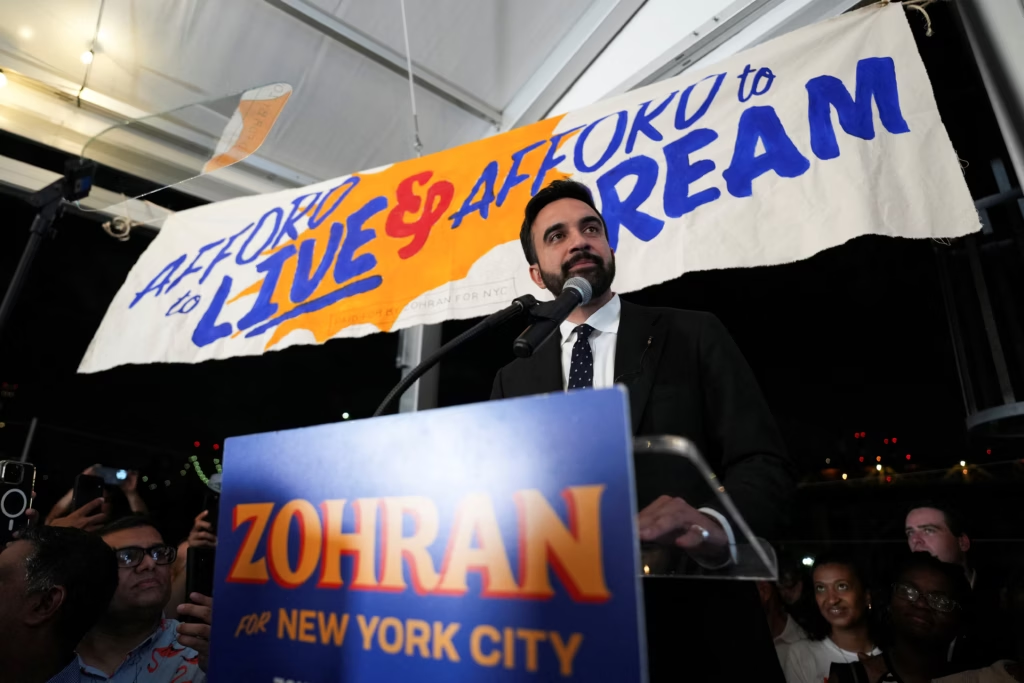
Besides the obvious difference in the number of voters to be convinced, Zohran’s exponential growth is due in part to his team’s savvy with social media and graphic design. Garnering youth votes through social media isn’t a new tactic; to reiterate, the Harris campaign used it as well. It is the content of the posts that has defined the differences in success.
Mamdani’s primary medium is moderately paced, engaging videos that often break down a policy of his or ask for support through money and volunteering. While his acknowledgement and references to pop culture are present, they do not overtake the message and often point back to the bedrock of his campaign—addressing the affordability crisis. Most also have a vibrant energy that seems missing from other political campaigns; instead of static explanations, Mamdani engages his audience by walking around the city and doing ordinary tasks while reiterating his proposals in simple, understandable language. In an opinion piece for the New York Times, author Zaina Arafat described the sense of belonging embedded in his videos: “The sight of subway platforms, Gyro Kings and Foot Lockers and threading salons on a city block, so commonplace that they usually go unnoticed as we hurry by, all lit up in their distinctly New York-ness… It’s the same feeling you get when watching a movie set in New York and recognize a particular coffee shop. I’ve been there. That coffee shop belongs to me.” This presentation makes him appear approachable and relatable, in contrast to the more refined, pretentious persona that politicians often adopt to maintain their dignity and assert their positions.

In accordance with his brand of being a common man, the iconography of his campaign is also unique in its vibrance and closeness to New York City. The main colors he uses for this logo—taxi yellow, an energetic red, and Metrocard blue—are eye-catching and easily identifiable, especially when compared to more subdued red, white, and blues that often represent general Democratic and Republican candidates. A drift from corporate aesthetics signifies a shift towards the people, appearing rooted in authenticity and culture. Even the typography was distinct, with “Zohran” in bright, bold letters, noticeably not in serif fonts. The graphic designer behind the visuals, Aneesh Bhoopathy, shared that the stylized font used and its primary colors were meant to evoke old-school, hand-painted signs, remarking, “Succinctly, it’s New York.” Others have noticed similarities between Zohran’s visuals and Bollywood posters, an especially important reference given Mamdani’s Indian heritage and the increasing political power of South Asians.
The Future of Leftist Politics
Many have hoped to paint Mamdani in a light that regards him as a turning point for Democratic politics—in Mike Johnson’s own words, “We are going to make Zohran Mamdani the face of the Democratic party.” During the New Jersey gubernatorial race, Republican Jack Ciattarelli also attempted to link Mamdani with Sherrill, claiming that “while she has tried to run away from it ever since, the fact is Mikie Sherrill endorsed Zohran Mamdani after he won the NYC mayoral primary—despite the fact that Mamdani is an anti-semitic socialist who wants to defund the police.” Despite widespread assertions from the far-right that the victory of the mayor-elect is a significant ideological shift for the Democrats, though, reality suggests otherwise; in a CBS News poll, just 22% of Democrats nationwide believed that their party should move toward more socialist positions, while a majority (60%) thought the party should maintain a mixture between socialist and capitalist ideas. However, the percentage of Democrats with a positive view of socialism has increased to 66%, and this number is similarly high for college students, with 67% holding a positive or neutral view. Even the Republican base may change its mind about Mamdani and his politics, given his warm exchange with the president last Friday, in which, in its aftermath, Trump and various conservative news outlets described Mamdani as “very rational” and wanting the best for New York City. On that front, only time will tell (MAGA for Mamdani?).

Whatever the future reveals, Mamdani’s win is no doubt remarkable for its time. As the first South Asian and Muslim mayor, his election represents a shift in political power and visibility toward South Asian voters, and an acceptance of America’s Muslim minority, which has been so ostracized in politics. And it is, of course, a win for the progressive left, inspiring other democratic socialist challengers within the Democratic Party to run against the establishment. These include Graham Platner, Abdul El-Sayed, Mussab Ali, Antonio Delgado, Saikat Chakrabarti, Kat Abughazaleh, Omar Fateh, and many more who have run or are running for local, state, and national seats. In just New York City, progressives are running to challenge more establishment incumbent Democrats. Michael Blake, Zohran’s former primary opponent who later cross-endorsed him, is running to unseat Ritchie Torres, a key aspect of his campaign being that Torres is too focused on Israel despite representing the poorest congressional district in the country. Brad Lander is rumored to be challenging Dan Goldman, another moderate Democrat who refused to endorse Mamdani despite his strong performance in his district. And although Zohran and DSA have discouraged it, progressive Chi Ossé may issue a primary challenge to the Democratic House Minority Leader Hakeem Jeffries.
Regardless, congrats to Zohran! For better or for worse, his mayoralty will be watched from all over the world.
Sources
https://www.nytimes.com/interactive/2025/11/04/nyregion/zohran-mamdani-wins-nyc-mayor-election-timeline.html
https://www.theguardian.com/us-news/commentisfree/2025/nov/08/zohran-mamdani-win-non-voters
https://www.nytimes.com/2025/11/04/nyregion/nyc-mayor-mamdani-elected.html
https://www.bbc.com/news/articles/cew44175vklo
https://www.nytimes.com/2025/10/08/nyregion/zohran-mamdani-israel-palestine.html
https://www.nytimes.com/2025/06/25/opinion/zohran-mamdani-democratic-party.html
https://www.usatoday.com/story/news/politics/2025/11/07/how-zohran-mamdani-won-nyc-mayor/86580734007/
https://www.opensecrets.org/news/2025/10/despite-a-surge-in-support-for-cuomo-mamdani-still-leads-nyc-mayoral-race-in-money-and-polling/
https://www.politico.com/news/2025/05/12/cuomo-super-pac-investigation-00341740


 1
1
 0
0

