Mind control has been depicted in movies, TV shows, and books for over a century. But is it really scientifically possible? The 2026 Nobel Prize in Physiology or Medicine may have just proved that it could be.
The Nobel Prize was awarded to Peter Hegemann, Georg Nagel, and Karl Deisseroth; specifically, for “optogenetics – a method that makes it possible to show how nerve cells shape memories, feelings, and behaviours in the living brain.”[1] So what is optogenetics, and what implications does it hold for neurological research and the potential development of mind control?

What Are Optogenetics?
The brain presents many scientific questions, but it also presents a significant problem: it is difficult to study. The main issue that scientists face is establishing causation.
Your brain cells, or neurons, are bundled into neural circuits – groups of interconnected neurons that work together that work together to perform a certain function. For example, your reflexes are the result of a neural circuit firing involuntarily. Other circuits are involved in more complex processes, like emotional responses.
Therein lies the problem that scientists face. For example, if a researcher observes a particular neural circuit becoming active when someone feels afraid, does that mean that that circuit causes fear? Or does it simply become active alongside the processes that produce fear?
To establish causation, researchers need a way to manipulate specific neurons and observe how the brain responds. And this is where optogenetics comes in.
Optogenetics allows scientists to have precise control over the activity of selected neurons. Researchers introduce genes encoding light-sensitive proteins, called opsins, into targeted cells. When exposed to specific wavelengths of light, these proteins alter the electrical activity of the cells in which they are expressed.
This provides a pathway for scientists to investigate how particular neural circuits contribute to behavior. Rather than simply watching the brain respond to an experience, scientists can measure what happens by directly altering the activity of the cells involved.
The Discovery
It all began with Peter Hegemann’s – a biophysicist at the Max Planck Institute – interest in a specific algae: Chlamydomonas. This single-celled alga is unique for its ability to detect and move towards light. He and Georg Nagel – another biophysicist at the Max Planck Institute – began to investigate the light-specific proteins that exist in this alga, and eventually, in 2002 and 2003, discovered two proteins: channelrhodosphin-1 and channelrhodosphin-2. Both were ion channels embedded in the cell membrane that opened when exposed to light, allowing ions to flow into the cell and change the cell’s electrical activity.[2]
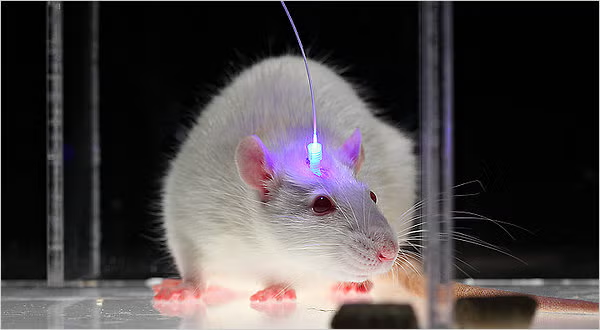
Karl Deisseroth, a psychiatrist and neuroscientist at Stanford University, built on this discovery. His research team was able to introduce the gene for channelrhodosphin-2 into mammalian neurons – specifically, in rats. In 2005, they demonstrated that by shining blue light on these neurons, they could precisely trigger electrical activity. This established the foundation for modern optogenetics and using light to manipulate neural circuits.

Mind Control?
So, if scientists can manipulate neural activity with light to influence behavior, does that mean that mind control could be scientifically possible?
It’s a far cry. While optogenetics does demonstrate that behavior can be influenced by manipulating the brain’s electrical activity, it is different from controlling someone’s thoughts, memories, or decisions. This research has also only been replicated in laboratory rats; it’s definitely a stretch to attempt to apply it to humans at this stage.
However, this discovery does present a lot more practical applications, like the treatment of neurological disorders, like Alzheimer’s and Parkinson’s disease, by allowing them to more precisely measure and examine the underlying neural circuits that are impacted by these diseases. The same applies to other psychiatric disorders, like anxiety. By establishing how specific circuits contribute to symptoms, scientists may be able to develop more precise treatments.
Ultimately, the significance of optogenetics is not that scientists have discovered a way to control the human mind. Rather, it is that we have gained a tool to understand our brains better, and develop ways to help heal them.


 0
 0